
Smart Growth Principle 9
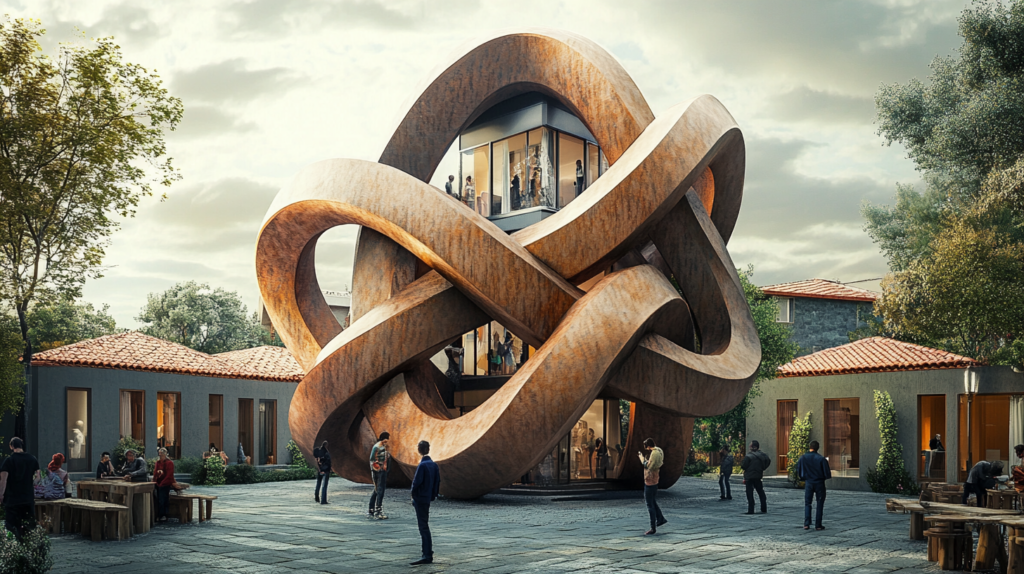
Photo by Paul Coogan using Midjourney
By Paul Coogan, Caroline McKeown, and Maggie Friend
What we build defines our communities, from the grand esplanade of Balboa Park to the large arched windows of the Jyoti-Bihanga vegetarian restaurant to our iconic church bell towers. A good build is one that fosters vitality in the urban environment with a design that reflects community personality and falls within local municipal guidelines.
These guidelines are reflected in city codes and incentives as well as local community plans.. Unfortunately, these bureaucratic documents create a complicated maze of restrictions rather than a cohesive vision for developers to follow.
Major projects, like the esplanade at Balboa Park or, more recently, SDSU West, have the scale and funding to start with a clean slate, but smaller projects in established communities must navigate both city and community guidelines. Developers, along with their architects and engineers, have to put together a project that is compliant while also being attractive to investors. The end product is hopefully aligned with the community’s vision but this may not always be the case, leading to uncertainty and frustration among all stakeholders.
But what if there were an easier way to communicate our community’s vision to developers, aligning the goals of the developer, the community, and the city? Our community would retain the character that makes it so attractive in the first place, the developer would have a clear and predictable guide to streamline the development process, and the city would spend less time and resources updating codes that are often ambiguous or in conflict with themselves.
Smart Growth provides a guide to a more predictable development plan that aligns with community vision encompassing the following six features :
Unified Development Code
Smart Growth advocates for a single document that includes all development-related city- and state-level regulations. Currently, San Diego maintains a municipal code with the most relevant section being chapter 14, however there are multiple other overlapping standards and programs including parking standards, ADU bonuses, the Complete Communities Program, Transportation Priority Area, Sustainable Development Area, Very High Fire Hazard Zones, Coastal Overlay Zones, and many other overlays and zoning exceptions that all need to be considered when building. It is easy to see how ensuring that a new build follows local guidelines and adheres to a community’s vision is extremely challenging. oTo make matters worse, many of the details are held in manuals only available at the Development Services Department.To help streamline local development, Smart Growth supports a single document for each area that would address the unique building requirements for that community.
Focusing on Form
Smart Growth advocates for code that outlines a specific urban “form” rather than zoning by use. This allows for more flexibility, similar to mixed-use zoning but primarily regulates the form of buildings to be more cohesive with the goals of Smart Growth. This method provides visual design instruction on development in addition to the standard policy-based written code. By focusing on form, the community defines an intentional vision and development is more predictable and easily aligned with the community plan.
Transit-Oriented Development
Moderate- to high-density, mixed-use neighborhoods built around transit stops and designed to maximize access to and use of public transportation is the Smart Growth goal. San Diego has a very mixed track record on achieving quality transit-oriented development. Apartment complexes built adjacent to trolley stations are excellent examples, while other projects have sprinkled mid-rise and even high-rise structures into neighborhoods of single story bungalows with limited access to public transit. Smart Growth advocates for development on transit corridors, and the expansion of public transit infrastructure to facilitate future transit-oriented growth.
Focus on Quality and Character
To maintain neighborhood character, Smart Growth advocates for including a set of standards that aims to maintain a certain level of quality and architectural or historic character, addressing features such as building façades, public spaces, and landscaping. San Diego has undermined historic preservation at every turn by keeping requirements for qualification high and review periods as short as possible as witnessed in the loss in 2023 of the “red bungalow” at 820 Fort Stockton Drive. However, working together with historic preservationists can help define and enhance a city’s character as seen with the now iconic incorporation of the Western Metal Supply Building into the Petco Park stadium design.
Street Design Standards
Guidelines and standards related to lane width, bicycle lanes, on-street parking, medians, sidewalks, landscaping, lighting, crosswalks, pedestrian refuge islands, bulbouts, and accessibility ramps can greatly enhance human scale factors that make our urban environment both friendly and safe. Furthermore, consistency in street design standards can help create and define a community.
Zoning Overlay
Currently standards for a designated portion of a community are used for historic districts but can also be used to identify areas for pedestrian friendly design. Overlays should be used sparingly however to prevent code complexity.
Using these six features, Smart Growth can transform development into a collaborative, additive process rather than a convoluted regulatory challenge. Neighborhoods with a well-defined vision that includes these features can streamline Smart Growth development that works with the community and for all the stakeholders.